What did the Greeks use to decide who should hold public office
Ancient Hellenic republic witnessed a wide multifariousness of authorities systems every bit people searched for the answers to such fundamental questions as who should rule and how? Should sovereignty lie in the rule of police force, the constitution, officials, or the citizens? Not settling on a definitive answer, governments in the Greek earth took extraordinarily diverse forms, from tyranny to democracy.
Across dissimilar Greek city-states and over many centuries, political power expressed itself in unlike forms of government, often in the aforementioned city as it evolved. Power could rest in the easily of a unmarried private, an elite or in every male denizen: democracy - widely regarded as the Greeks' greatest contribution to civilization.
The iv most common systems of Greek government were:
- Democracy - rule by the people (male person citizens).
- Monarchy - rule by an individual who had inherited his role.
- Oligarchy - rule by a select group of individuals.
- Tyranny - rule by an individual who had seized ability by unconstitutional ways.
Our knowledge of the political systems in the ancient Greek world comes from a wide range of sources. Whilst for Athens, it is possible to slice together a more complete history, nosotros take simply an incomplete flick of the systems in most city-states and many details of how the political apparatus actually functioned are missing. Surviving, though, are over 150 political speeches and 20,000 inscriptions which include 500 decrees and 10 laws. There are also two specifically political texts with the same championship, The Constitution of the Athenians, ane written by Aristotle or one of his pupils and the other attributed (by some) to Xenophon. Other sources which discuss politics and government include Aristotle's Politics and the historical works of Herodotus, Thucydides, and Xenophon. In addition, politics is frequently lampooned in the comedies of Aristophanes.
Democracy
Athens' constitution is called a commonwealth because it respects the interests not of the minority but of the whole people. When it is a question of settling private disputes, everyone is equal before the constabulary; when information technology is a question of putting i person earlier another in positions of public responsibility, what counts is not membership of a particular course, merely the actual power which the man possesses. (Pericles, 431 BCE)
Whatever male citizen 18 years or over could speak (at least in theory) & vote in the assembly of Athens.
The word commonwealth derives from the Greek dēmos which referred to the unabridged denizen trunk and although it is Athens which has get associated with the birth of democracy (demokratia) from around 460 BCE, other Greek states did constitute a similar political system, notably, Argos, (briefly) Syracuse, Rhodes, and Erythrai. Athens is, still, the state we know nigh about. The associates of Athens met at to the lowest degree once a month, perhaps 2 or three times, on the Pnyx hill in a dedicated space which could accommodate 6000 citizens. Any male person citizen 18 years or over could speak (at to the lowest degree in theory) and vote in the assembly, usually with a elementary show of hands. Omnipresence was even paid for in certain periods which was a measure to encourage citizens who lived far away and couldn't afford the time-off to attend.
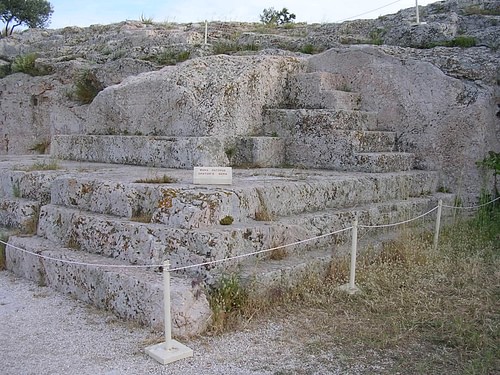
Speaker's Platform, Athens Associates, Pynx, Athens
Citizens probably accounted for 10-20% of the polis population, and of these information technology has been estimated that only 3,000 or so people actively participated in politics. Of this group, perhaps as few every bit 100 citizens - the wealthiest, most influential, and the best speakers - dominated the political arena both in front of the assembly and backside the scenes in private conspiratorial political meetings (xynomosiai) and groups (hetaireiai). Critics of republic, such as Thucydides and Aristophanes, besides pointed out that the dēmos could be as well easily swayed past a good orator or popular leaders (the demagogues) and get carried away with their emotions. Perhaps the nearly famous bad decision from the Athenian republic was the death judgement given to the philosopher Socrates in 399 BCE.
Issues discussed in the assembly ranged from deciding magistracies to organising and maintaining food supplies to debating military matters. At that place was in Athens (and besides Elis, Tegea, and Thasos) a smaller body, the boulē, which decided or prioritised the topics which were discussed in the assembly. In add-on, in times of crisis and war, this body could as well take decisions without the assembly coming together. The boulē or council of 500 citizens was chosen by lot and had a limited term of role, which acted equally a kind of executive commission of the assembly. The decrees of the Assembly could also be challenged by the law courts. Similar in function to the boulē was the council of elders (selected men over lx), the gerousia, of Sparta, which too had the two Spartan kings as members and had certain legal powers. Like bodies of elders existed in Corinth and Stymphalos. In Athens, the Areopagus was a similar such council, where elders were made members for life.
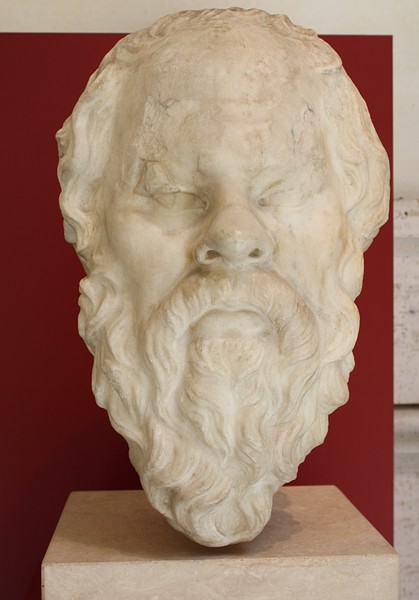
Socrates Bust, Palazzo Massimo
In other Greek states then, in that location were too democratic assemblies, sometimes, though, with a minimum property stipulation for attendees (as in the Boiotian federation 447-386 BCE). Some city-states besides mixed democratic assemblies with a monarchy (for example, Macedonia and Molossia).
The kings of Sparta were kept in bank check past ephors (ephoroi) who were themselves elected by the assembly.
Monarchy
In the Greek world monarchies were rare and were oftentimes only distinguishable from a tyranny when the hereditary ruler was more benevolent and ruled in the 18-carat involvement of his people. The most famous monarchies were those in united states of Republic of macedonia and Epeiros, where the ruler shared power with an assembly, express though these were in practice. Although Sparta as well possessed a citizen associates, it is most famous for its organization of ii kings. Not absolute monarchs, they did, nevertheless, hold smashing ability when they led the Spartan ground forces in times of state of war. During peacetime the kings were kept in check past ephors (ephoroi) who were themselves elected by the assembly. Clearly, a degree of political consensus was necessary for this overlapping apparatus to function. The kings were besides members of the gerousia and were admitted from a young age, so that they must have had a meaning advantage over the other members who couldn't join until they were threescore. Spartan kings could, even so, be put on trial and even exiled.
Tyranny
Tyrants were sole rulers of a country who had taken power in an unconstitutional manner, often murdering their predecessor. However, Greek tyrants were non necessarily evil rulers (as the discussion signifies today); they simply looked after their own interests. Syracuse in Sicily had a run of famous tyrants, for case, Dionysios from 405 BCE and his son Dionysios Ii, who took over in 367 BCE. Others include Peisistratos in Athens (from c. 560 BCE) - a typical benevolent tyrant who actually paved the fashion for democracy, Pheidon in Argos (c. 660 BCE), Lycophron in Thessaly, the Kypselidai, which included Periander, in Corinth (c. 657-585 BCE), and Polycrates in Samos (530-522 BCE). For Athenians, tyranny became the exact opposite of democracy, a position that allowed the citizens of Athens to experience a certain superiority. This feeling was specially evidenced in the demonizing of the Persian kings Darius and Xerxes, the tyrants par excellence.
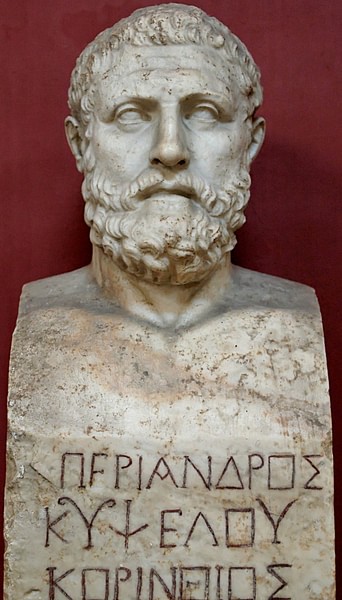
Periander
Oligarchy
An oligarchy is a system of political power controlled by a select group of individuals, sometimes minor in number but it could also include large groups. For the Greeks (or more peculiarly the Athenians) any organisation which excluded ability from the whole citizen-trunk and was non a tyranny or monarchy was described as an oligarchy. Oligarchies were mayhap the most common class of metropolis-state government and they oft occurred when republic went wrong. Unfortunately, information apropos oligarchies in the Greek world is sparse. Nosotros know that in 411 BCE in Athens, 'the oligarchy of the 400' took power out of the hands of the Assembly and were themselves superseded by a more than moderate oligarchy of 5000. In 404 BCE, following the defeat of the Athenian armed forces forces in Sicily, there was an oligarchy of 'the Thirty Tyrants' in Athens which was a particularly brutal government, noted for its summary executions. Megara and Thebes were other states which had an oligarchic organization.
In that location was a sure expectation that the honourable citizen would play his active part in civic life.
Public Officials
In Athens the police was devised and enforced by magistrates (archai). All citizens were eligible for the position, and indeed there may well have been a certain expectation that the honourable citizen would play his active part in civic life. For the Greeks, the land was not seen as an interfering entity which sought to limit ane'southward freedom but as an apparatus through which the individual could fully express his membership of the community. The regular turnover of archai, due to express terms of office and the prohibition of re-election, meant abuse of ability was kept in check and the rulers would, in plough, get the ruled. Various boards of officials also existed to make administrative decisions; members of these were usually taken from each of the ten traditional tribes. Many civic positions were brusk-term and called by lot to ensure bribery was kept to a minimum. Importantly, positions of power often required not only free time simply also fiscal layout to fund municipal projects such as shipbuilding and festivals. Therefore, it was probably the case that public positions were in reality dominated by the wealthier citizens.
In Sparta, the most important state officials were the five ephors. These were probably elected past the assembly of Sparta and they held office for only one year. Yet, during that time they had power over about areas of civic life and they could appoint and bank check on all the other public officials.
Armed services commanders also held public office in some city-states. In Athens, the lath of ten elected generals, known equally the strategoi, could influence the agenda of the assembly and then prioritise their own causes. They were subject to votes of confidence by the Associates but this didn't stop Pericles, for example, holding role as strategos for 15 consecutive years.
This article has been reviewed for accuracy, reliability and adherence to academic standards prior to publication.
Source: https://www.worldhistory.org/Greek_Government/
0 Response to "What did the Greeks use to decide who should hold public office"
Post a Comment