If Found Not Guilty by Jury
Jury nullification (US/UK), jury disinterestedness [1] [two] (UK), or a perverse verdict (UK)[iii] [4] describes a non guilty verdict of a criminal trial's jury despite a defendant having clearly cleaved the law. Reasons may include beliefs that: the police force itself is unjust,[5] [half dozen] the prosecutor has misapplied the police force in the defendant's case,[vii] the punishment for breaking the police is also harsh, or full general frustrations with the criminal justice system. Some juries have likewise refused to convict due to their own prejudices in favor of the defendant.[8] Such verdicts are possible because a jury has an accented and unqualified right to reach whatsoever verdict it chooses, although they are usually not told of this right in the procedure of a trial.[nine]
Nullification is not an official role of criminal procedure, only is the logical result of two rules governing the systems in which information technology exists:
- Jurors cannot exist punished for reaching a "wrong" decision (such as acquitting a defendant despite their guilt beingness proven beyond a reasonable doubt).[ten]
- A defendant who is acquitted cannot in many jurisdictions be tried a second time for the same offence.[11]
A jury verdict that is opposite to the letter of the constabulary pertains simply to the item instance before information technology. However, if a pattern of acquittals develops in response to repeated attempts to prosecute a item offence, this can have the de facto outcome of invalidating the constabulary. Such a design may indicate public opposition to an unwanted legislative enactment. It may also happen that a jury convicts a defendant even if no law was broken, although such a conviction may be overturned on appeal. Nullification can likewise occur in ceremonious trials.
Background [edit]
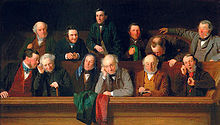
In the by, it was feared that a single judge or panel of authorities officials might be unduly influenced to follow established legal do, even when that practice had drifted from its origins. In almost modern Western legal systems, judges ofttimes instruct juries to human activity just as "finders of fact", whose role it is to make up one's mind the veracity of the evidence presented, the weight accorded to the prove,[12] to utilize that evidence to the police as explained by the judge, and to achieve a verdict; but non to question the police itself. Similarly, juries are routinely cautioned by courts and some attorneys not to allow sympathy for a political party or other affected persons to compromise the fair and dispassionate evaluation of evidence. These instructions are criticized by advocates of jury nullification. Some usually cited historical examples of jury nullification involve jurors refusing to captive persons defendant of violating the Fugitive Slave Act past assisting delinquent slaves or existence fugitive slaves themselves, and refusal of American colonial juries to convict a defendant under English language law.[13]
Jury nullification is the source of much debate. Some maintain that it is an important safeguard of last resort against wrongful imprisonment and authorities tyranny.[14] [xv] Others view it as a violation of the right to a jury trial, which undermines the police.[xv] Some view information technology equally a violation of the adjuration sworn past jurors. In the United States, some view the requirement that jurors take an oath to be unlawful in itself, while still others view the oath'south reference to "deliverance" to require nullification of unjust law: "will well and truly try and a true deliverance make betwixt the United States and the defendant at the bar, and a truthful verdict return according to the evidence, so aid [me] God". The states v. Dark-green , 556 F.2d 71 (D.C. Cir. 1977).[xvi] Some fear that nullification could be used to permit violence against socially unpopular factions.[17] They signal to the danger that a jury may choose to convict a accused who has not broken the letter of the constabulary. However, judges retain the rights both to decide sentences and to condone juries' guilty verdicts, acting as a check against malicious juries. Jury nullification may also occur in civil suits, in which the verdict is generally a finding of liability or lack of liability (rather than a finding of guilty or not guilty).[18]
The main ethical upshot involved in jury nullification is the tension betwixt autonomous self-regime and integrity.[19] The argument has been raised that prosecutors are non allowed to seek jury nullification, and therefore defendants should non be allowed to seek it either.[20] Yet, for a prosecutor to nullify a police in this context would require negating the presumption of innocence. (For this reason, prosecutorial nullification is typically divers as failing to prosecute.)[21]
All the same, at that place is picayune doubt as to the power of a jury to nullify the law. Today, there are several issues raised by jury nullification, such as:
- whether juries can or should be instructed or informed of their power to nullify.
- whether a guess may remove jurors "for cause" when they reject to apply the law equally instructed.
- whether a judge may punish a juror for practicing jury nullification.
- whether all legal arguments, except perhaps on motions in limine to exclude prove, should exist made in the presence of the jury.
In some cases in the United States, a stealth juror will attempt to go on a jury in order to nullify the law.[22] Some lawyers use a shadow defence to expose the jury to information that would otherwise be inadmissible, hoping that evidence volition trigger a nullification.[23] [24]
Mutual constabulary precedent [edit]

The early on history of juries supports the recognition of the de facto power of nullification. Past the 12th century, mutual law courts in England began using juries for more than authoritative duties. Juries were composed primarily of "laymen" from the local community and provided a somewhat efficient means of dispute resolution with the do good of supplying legitimacy.
The general power of juries to decide on verdicts was recognised in the English Magna Carta[25] of 1215, which put into words existing practices:
No free human shall be captured, and or imprisoned, or disseised of his freehold, and or of his liberties, or of his free customs, or be outlawed, or exiled, or in whatever way destroyed, nor will nosotros proceed against him by force or proceed against him by artillery, but by the lawful judgment of his peers, or past the law of the land.
For a trivial offence, a free human shall be fined just in proportion to the degree of his offence, and for a serious offence correspondingly, but not so heavily as to deprive him of his livelihood. In the same way, a merchant shall be spared his merchandise, and a husbandman the implements of his husbandry, if they fall upon the mercy of a royal court. None of these fines shall exist imposed except past the assessment on oath of reputable men of the neighbourhood.
Largely, the earliest juries returned verdicts in accordance with the approximate or the Crown. This was achieved either by "packing the jury" or by "writ of attaint". Juries were packed past manus-selecting or past bribing the jury so as to return the desired verdict. That was a mutual tactic in cases involving treason or sedition. In addition, the writ of attaint allowed a judge to retry the case in front of a second jury when the guess believed the first jury returned a "false verdict". If the 2d jury returned a different verdict, that verdict was imposed, and the starting time jury was imprisoned or fined.
That history is marked past a number of notable exceptions. In 1554, a jury acquitted Sir Nicholas Throckmorton merely was severely punished by the court. Virtually a century afterwards, in 1649, in the first known attempt to contend for jury nullification, a jury too acquitted John Lilburne for his part in inciting a rebellion against Oliver Cromwell'south regime. The theoretician and politico Eduard Bernstein wrote of Lilburne's trial:
His contention that the constitution of the Court was opposite to the fundamental laws of the land was unheeded, and his claim that the jury was legally entitled to judge not just equally to matters of fact but also as to the awarding of the police itself, as the Judges represented merely 'Norman intruders', whom the jury might here ignore in reaching a verdict, was described by an enraged judge as 'damnable, blasphemous heresy'. This view was not shared by the jury, which, subsequently three days' hearing, acquitted Lilburne—who had dedicated himself as skillfully equally whatsoever lawyer could have done—to the great horror of the Judges and the chagrin of the bulk of the Quango of Land. The Judges were and so astonished at the verdict of the jury that they had to repeat their question earlier they would believe their ears, but the public which crowded the judgment hall, on the announcement of the verdict, bankrupt out into thanks and then loud and long equally, co-ordinate to the unanimous testimony of contemporary reporters, had never before been heard in the Guildhall. The cheering and waving of caps continued for over half an hour, while the Judges saturday, turning white and blood-red in turns, and spread thence to the masses in London and the suburbs. At night bonfires were lighted, and fifty-fifty during the post-obit days the event was the occasion of joyful demonstrations.[26]
In 1653, Lilburne was on trial again and asked the jury to carry him if information technology found the death penalty "unconscionably severe" in proportion to the criminal offence he had committed. The jury found Lilburne "not guilty of whatever offense worthy of decease".[27]
In 1670, a petit jury refused to convict William Penn of unlawful associates in Bushel's Case. The judge attempted to find the jury in antipathy of court, which was ruled inappropriate by the Court of Common Pleas.
In 1681, a thousand jury refused to indict the Earl of Shaftesbury. In 1688, a jury acquitted the Seven Bishops of the Church of England of seditious libel. Juries connected, fifty-fifty in non-criminal cases, to act in defiance of the Crown. In 1763 and 1765, juries awarded £four,000 to John Wilkes and £300 to John Entick in split up suits for trespass against the Crown'due south messengers. In both cases, messengers had been sent by Lord Halifax to seize allegedly-libellous papers.[ citation needed ]
In Scotland, jury nullification had the profound effect of introducing the iii-verdict system including the option of "not proven", which remains in Scotland to this day. In 1728, Carnegie of Finhaven accidentally killed the Earl of Strathmore. As the defendant had undoubtedly killed the Earl, the law, equally information technology then stood, required the jury simply to look at the facts and to pass a verdict of "proven" or "non proven", depending on whether it believed that the facts proved the accused had killed the Earl.[ citation needed ] If the jury brought in a "proven" verdict, that would lead to Carnegie's hanging though he had not intended any harm to the Earl. To avert that injustice, the jury decided to assert what information technology believed to be its "ancient right" to judge the whole case, not just the facts, and rendered the verdict of "non guilty". Over time, juries accept tended to favour the "not guilty" verdict over "not proven" so the interpretation has inverse. The "not guilty" verdict has become the normal verdict when a jury is convinced of innocence, and the "not proven" verdict is used only if the jury is not certain of innocence or guilt.[ citation needed ]
The standard jury trial exercise in the United States during the Founding Era and for several decades afterward was to fence all issues of law in the presence of the jury so that it heard the same arguments every bit the bench in reaching its rulings on motions. That is evidenced past such decisions equally the 1839 case Stettinius, which held, "The defence force can contend police to the jury before the court gives instructions."[28] After, judges began to demand the parties submit motions in writing, frequently before the jury was empaneled, to be argued and decided without the jury being nowadays. The transition began with motions in limine to exclude evidence on which it was felt the jury should non hear the argument considering it would be informed of the show to be excluded. After, that was expanded to include all legal statement and so that today, the earlier practice of arguing police force before the jury has been largely forgotten, and judges even declare mistrials or overturn verdicts if legal arguments are made to the jury.[ commendation needed ]
Specific jurisdictions [edit]
Germany [edit]
In 1921, the Armenian genocide survivor Soghomon Tehlirian assassinated Talat Pasha, who was considered the main builder of the genocide, in Berlin. Although Tehlirian'due south lawyers did not contest that their client had killed Talat, the jury (Germany used jury trials until 1924) returned a verdict of not guilty.[29] [30]
Canada [edit]
Although extremely rare, jury nullification occurs in Canada. As the prosecution has powers to appeal the resulting amortization, it lacks the finality found in the United states. However, the Crown cannot appeal on grounds of an unreasonable amortization although it tin entreatment on errors of law. In R. v. Latimer, 2001 SCC 1,[31] the Supreme Court discussed jury nullification and indicated that information technology is a duty of the presiding justice to try to preclude it from occurring.
Perhaps the nigh famous cases of jury nullification in Canada were the various trials of Henry Morgentaler, who openly operated a private abortion dispensary in violation of the Criminal Code. Repeated attempts at prosecuting Morgentaler resulted in acquittals at jury trials in the 1970s and the 1980s. In the 1988 Supreme Court case, R. 5. Morgentaler, 1988 SCR 30,[32] a nullification was appealed all the way to the country'south highest court, which struck down the law in question. In obiter dicta, Chief Justice Dickson wrote:
The opposite principle contended for by Mr. Manning, that a jury may be encouraged to ignore a law it does not like, could lead to gross inequities. One defendant could be bedevilled past a jury who supported the existing law, while some other person indicted for the same offence could be acquitted past a jury who, with reformist zeal, wished to limited disapproval of the aforementioned law. Moreover, a jury could determine that although the police pointed to a conviction, the jury would simply reject to apply the law to an defendant for whom it had sympathy. Alternatively, a jury who feels antipathy towards an accused might convict despite a law which points to amortization. To give a harsh, simply I think telling example, a jury fueled by the passions of racism could be told that they need non apply the law against murder to a white man who had killed a black man. Such a possibility need only be stated to reveal the potentially frightening implications of Mr. Manning's assertions.... Information technology is no doubtfulness true that juries have a de facto ability to disregard the constabulary as stated to the jury past the judge. We cannot enter the jury room. The jury is never called upon to explain the reasons which lie behind a verdict. It may fifty-fifty be true that in some limited circumstances the individual determination of a jury to refuse to apply the police will constitute, in the words of a Law Reform Commission of Canada working paper, "the citizen's ultimate protection confronting oppressive laws and the oppressive enforcement of the police force" (Law Reform Committee of Canada, Working Newspaper 27, The Jury in Criminal Trials (1980)). But recognizing this reality is a far cry from suggesting that counsel may encourage a jury to ignore a law they exercise not back up or to tell a jury that it has a right to do and then.
The Supreme Court in 2006 issued a determination, R. v. Krieger, 2006 SCC 47,[33] which confirmed that juries in Canada accept the power to refuse to apply the constabulary when their consciences crave that they do so. The determination stated that "juries are not entitled as a matter of right to decline to utilize the law—merely they do have the ability to practise so when their consciences allow of no other course".[33]
England and Wales [edit]
By the late 17th century, the court'due south power to punish juries was removed in Bushel's Case [34] involving a juror on the case confronting William Penn. Penn and William Mead had been arrested in 1670 for illegally preaching a Quaker sermon and agonizing the peace, but 4 jurors, led past Edward Bushell, refused to find them guilty. Instead of dismissing the jury, the judge sent them dorsum for farther deliberations. Despite the estimate enervating a guilty verdict, the jury now unanimously found Penn guilty of preaching but acquitted him on the charge of disturbing the peace and acquitted Mead of all charges. The jury was then subsequently kept for 3 days without "meat, drink, fire and tobacco" to force information technology to bring in a guilty verdict. When it failed to do so, the judge ended the trial. Every bit punishment, the judge ordered the jurors imprisoned until they paid a fine to the court.

Four jurors refused to pay the fine, and afterward several months, Bushell sought a writ of habeas corpus. Chief Justice Vaughan, sitting on the Court of Common Pleas, discharged the writ, released them, called the power to punish a jury "absurd" and forbade judges from punishing jurors for returning a verdict the judge disagreed with.[35] That series of events is considered a significant milestone in the history of jury nullification.[36] The "backbone and endurance" of the jury is historic in a plaque displayed in the Central Criminal Court (the Old Bailey) in London.
In a criminal libel case, R. 5. Shipley (1784), 4 Dougl. 73, 99 Due east.R. 774, at p. 824, Lord Mansfield, sitting as a judge in the case, disparaged the do of jury nullification:
So the jury who usurp the judicature of police force, though they happen to exist correct, are themselves wrong, considering they are correct by chance only, and take not taken the constitutional mode of deciding the question. It is the duty of the Estimate, in all cases of full general justice, to tell the jury how to do right, though they have it in their ability to do wrong, which is a matter entirely between God and their own consciences.
To be free is to live under a government by police.... Miserable is the condition of individuals, dangerous is the status of the State, if there is no sure police force, or, which is the same matter, no certain administration of law, to protect individuals, or to guard the State.
...
In opposition to this, what is contended for? – That the law shall exist, in every particular cause, what any twelve men, who shall happen to exist the jury, shall be inclined to think; liable to no review, and subject to no command, nether all the prejudices of the popular cry of the day, and under all the bias of interest in this boondocks, where thousands, more or less, are concerned in the publication of newspapers, paragraphs, and pamphlets. Under such an administration of law, no man could tell, no counsel could advise, whether a newspaper was or was not punishable [for publishing a libel].
A 2016 report exploring the history of juror punishment in England and Wales later Bushel's Case plant no clear examples of jurors existence punished solely for returning the "wrong" verdict. The closest that a jury came to that was in 1917, when a jury acquitted two teenage boys of arson. The boys had confessed at their pre-trial hearing but entered pleas of not guilty at their trial. Home Role civil servants suspected the difference between the pleas could be explained by the difference between the boys' admitting that they had caused the fire and their deprival that they had washed so maliciously. The trial guess did non consider that possibility or was not satisfied with information technology. On receiving the jury'due south verdict, he told them that "y'all have been absolutely regardless of your adjuration. These men have pleaded guilty, and the evidence is of the clearest possible nature. You are none of you fit to serve on a Jury, but you will remain hither until the end of the Sessions".
The foreman, George Lathan, considered that a form of punishment for the jury, equally the jurors were not going to be permitted to serve on whatsoever more juries but were nonetheless required to continue attending court or face antipathy proceedings, which Lathan considered a tacit course of imprisonment. Officials in the Lord Chancellor'due south Function noted that while the judge's conduct "was ill-judged and arbitrary, he did not, so far as I tin can come across, do any act which would justify the Lord Chancellor in removing him from the Bench". Home Office officials wrote to the estimate, advising him that his actions "would be impossible for the Home Secretarial assistant to defend as constitutional or right", and after several days, the jurors were relieved of their duties. Home Office minutes suggest they did not retrieve that kind of informal penalisation of jurors who had returned the "incorrect" verdict to exist unheard of.[37]
In 1982, during the Falklands War, the British Royal Navy sank an Argentine cruiser, the ARA General Belgrano. Three years afterward a civil servant, Clive Ponting, leaked two government documents concerning the sinking of the cruiser to a Member of Parliament (Tam Dalyell) and was subsequently charged with breaching section 2 of the Official Secrets Human activity 1911.[38] The prosecution in the case demanded for the jury to convict Ponting, as he had conspicuously contravened the Act by leaking official information about the sinking of the Belgrano during the Falklands State of war. His master defence was that information technology was in the public interest that the information be made bachelor. The judge, Sir Anthony McCowan, "indicated that the jury should convict him",[39] and had ruled that "the public interest is what the authorities of the day says it is".[xl] All the same, the jury acquitted him, much to the consternation of the government.
In 2021, 6 activists associated with the environmental protest organisation Extinction Rebellion were tried for causing criminal harm to the British headquarters of the multinational oil company Royal Dutch Shell. The guess instructed the jury that there was 'no defence in police force' for the protestors' deportment, which according to the prosecutor had caused 'significant damage' to the edifice, simply the activists were acquitted past the jury.[41] [42]
Usa [edit]
In the United States, jury nullification starting time appeared just earlier the American Revolutionary State of war, when colonial juries often exercised their nullification power, principally in maritime cases and cases implicating free speech. Jury nullification became so common that many British prosecutors gave up trying maritime cases since conviction seemed hopeless.[43] Earlier the American Ceremonious War, juries sometimes refused to convict for violations of the Fugitive Slave Act. Subsequently, during Prohibition, juries often nullified alcohol control laws.[44] That resistance may have contributed to the adoption of the Twenty-starting time Subpoena, which repealed Prohibition and the Eighteenth Amendment.
In a well-known example of jury nullification, at the end of Wild Bill Hickok's trial for the manslaughter of Davis Tutt in 1865, Approximate Sempronius Boyd gave the jury two instructions. He first instructed the jury that a confidence was its only pick under the law. He then instructed them that they could utilise the unwritten constabulary of the "fair fight" and acquit. Hickok was acquitted; the verdict was not popular with the public.[45] [46]
Avoiding Slave Act [edit]
Juries beyond the Northward acquitted defendants who had clearly breached the Fugitive Slave Deed in the 1850s. Part of the Compromise of 1850, it had been passed to mollify Southern slaveowners, who were otherwise threatening to secede from the Union.
Secretary of State Daniel Webster was a key supporter of the constabulary as expressed in his famous "Seventh of March" speech. He wanted loftier-profile convictions, only the jury nullifications ruined his presidential aspirations and his last-ditch efforts to find a compromise between North and South. Webster led the prosecution when defendants were accused of rescuing Shadrach Minkins in 1851 from Boston officials who intended to return Minkins to his possessor. The juries convicted none of the men. Webster tried to enforce a law that was extremely unpopular in the North, and his Whig Party passed over him again when it chose a presidential nominee in 1852.[47]
Subsequently Civil War [edit]
White defendants accused of crimes against black people and other minorities were frequently acquitted by all-white juries, particularly in the South, even in the face of irrefutable evidence.[48]
21st century [edit]
In the 21st century, many discussions of jury nullification center on drug laws, which some consider unjust in principle or because they are seen to discriminate against certain groups.[49] A jury nullification advancement group estimates that 3–4% of all jury trials involve nullification,[50] and a recent ascent in hung juries is seen by some as being indirect evidence that juries accept begun to consider the validity or the fairness of the laws themselves.[51]
Judicial opinion [edit]
In the 1895 case of Sparf v. U.s.a., written by Justice John Marshall Harlan, the United states of america Supreme Court held 5-iv that a trial approximate has no responsibility to inform the jury of the right to nullify laws.[52] That decision, often cited, has led to a common exercise by US judges to penalize anyone who attempts to present a nullification statement to jurors and to declare a mistrial if such statement has been presented to them. In some states, jurors are likely to be struck from the panel during voir dire if they do not agree to accept equally correct the rulings and instructions of the law equally provided by the judge.[53]
In subsequently rulings the courts connected to prohibit informing juries about jury nullification. In a 1969, Fourth Circuit Court of Appeals decision, U.S. v. Moylan, 417 F.2nd 1002 (4th Cir.1969), the Courtroom affirmed the concept of jury nullification, but upheld the power of a courtroom to refuse to permit an instruction to the jury to this effect.[54] In 1972, in United States five. Dougherty, 473 F.2d 1113, the Us Court of Appeals for the District of Columbia Circuit issued a ruling similar to Moylan that affirmed the de facto ability of a jury to nullify the constabulary simply upheld the deprival of the defense's take chances to instruct the jury about the power to nullify.[55]
In 1988, the Sixth Circuit upheld a jury instruction: "There is no such thing as valid jury nullification." In United States v. Thomas (1997), the Second Excursion ruled that jurors can exist removed if there is bear witness that they intend to nullify the law. The Supreme Court has non recently confronted the issue of jury nullification.
In 2017, a jury was instructed: "Yous cannot substitute your sense of justice, whatever that means, for your duty to follow the police, whether you concur with information technology or not. It is not for y'all to decide whether the constabulary is just or whether the law is unjust. That cannot exist your chore. There is no such thing every bit valid jury nullification. You would violate your oath and the police force if you willfully brought a verdict contrary to the law given to yous in this instance." The 9th Circuit upheld the first three sentences of the jury's didactics and overruled the remainder only deemed that instruction a harmless error and affirmed the conviction.[56]
State laws [edit]
![[icon]](https://upload.wikimedia.org/wikipedia/commons/thumb/1/1c/Wiki_letter_w_cropped.svg/20px-Wiki_letter_w_cropped.svg.png) | This section needs expansion. You tin help by adding to it. (July 2013) |
In 2002, South Dakota voters rejected past a 78% margin a state constitutional subpoena to permit criminal defendants to debate for jury nullification.[57]
On June xviii, 2012, New Hampshire passed a law explicitly allowing defense attorneys to inform juries about jury nullification.[58] On October 24, 2014, the New Hampshire Supreme Courtroom effectively nullified the law and held that the wording of the statute does not let defense attorneys to tell juries they can nullify a law.[59] [threescore]
Come across as well [edit]
- Citizens Rule Book
- Fully Informed Jury Clan
- Josephine Terranova
- Judgment all the same verdict
- Judicial override
- Jury nullification in the United States
- Ultimate fact
- Jury Nullification (volume)
References [edit]
- ^ "What is jury equity?". eNotes . Retrieved March 23, 2020.
- ^ "The Cheshire Cab Driver: Reasons of Conscience". Volteface . Retrieved March 23, 2020.
- ^ Bethel G. A. Erastus-Obilo (October thirty, 2008). "13: The 'Perverse' Verdict". The Place of the Explained Verdict in the English Criminal Justice System: Decision-making and Criminal Trials. Universal-Publishers. pp. 197–. ISBN978-one-59942-689-1.
- ^ David Hewitt (May 1, 2018). "'Not just a correct, but a duty': A history of perverse verdicts". The Justice Gap. Archived from the original on September 9, 2019. Retrieved September 8, 2019.
- ^ Trial of the Quaker William Penn (founder of Pennsylvania), 1670
- ^ Trial of Penn and Mead Archived March 24, 2016, at the Wayback Machine
- ^ Clive Ponting and "Troubled history of Official Secrets Act", 1985 Archived January xv, 2016, at the Wayback Machine
- ^ Kennedy, Randall. "Racial Deport by Jurors and Judges: The Problem of the Tainted Conviction", pp. 277-282, and "Black Ability in the Jury Box?", pp. 295-310, Race, Crime and the Law (1997).
- ^ Duane, James (1996). "Jury Nullification: The Elevation Secret Constitutional Right" (PDF). Litigation. 22 (4): 6–60.
- ^ Radley Balko (August 1, 2005), Justice Ofttimes Served By Jury Nullification, Fox News
- ^ Clay S. Conrad (1995), Jury Nullification as a Defense Strategy, ii TEX. F. ON C.L. & C.R. 1, 1-2
- ^ Graves, Dr Frederick D. (2009), "Fact definition", Jurisdictionary, archived from the original on December 26, 2009, retrieved Jan 4, 2010
- ^ Gaspee Affair Archived April 20, 2016, at the Wayback Machine
- ^ William C. Heffernan, John Kleinig, From Social Justice to Criminal Justice: Poverty and the Administration of Criminal Law, Contributor William C. Heffernan, John Kleinig, (Oxford University Press US, 2000)ISBN 0195129857, ISBN 978-0-19-512985-4, p. 219
- ^ a b Randolph Northward. Jonakait, The American Jury System (Yale University Press, 2006), p. 253 ISBN 0-300-12463-five, ISBN 978-0-300-12463-7
- ^ Barbara J. Shapiro A Civilisation of Fact: England, 1550-1720, (Cornell University Printing, 2003), p. 21 ISBN 0-8014-8849-4, ISBN 978-0-8014-8849-8
- ^ "Recognising the Activist Juror", Deliberations: Law, news and thoughts on juries and jury trials, June 12, 2007, retrieved January iv, 2010
- ^ Lars Noah, "Ceremonious Jury Nullification", Iowa Police Review 86 (2001): 1601
- ^ Schopp, Robert F. (1995–1996), Verdicts of Conscience: Nullification and Necessity equally Jury Responses to Crimes of Conscience, vol. 69, S. Cal. L. Rev., p. 2039
- ^ Bissell, John W. (1997–1998), Comments on Jury Nullification, vol. 7, Cornell Journal of Law and Public Policy, p. 51
- ^ Fairfax, Roger A. (2011), Prosecutorial Nullification (PDF), Boston Higher Law Review
- ^ The Stealth Juror: Reality or Rarity?, American Bar Association, archived from the original on Nov 21, 2008
- ^ Hall Jr., John Wesley (2003), Putting on a Jury Nullification Defense and Getting Away with It
- ^ Conrad, Clay (1998), Using Theories and Themes to Acquit the Guilty
- ^ Magna Carta of 1215 Archived September 10, 2014, at the Wayback Machine
- ^ Eduard Bernstein, Sozialismus und Demokratie in der grossen englischen Revolution (1895); trans. H. J. Stenning (1963, NYC) every bit Cromwell and Communism: Socialism and Commonwealth in the Great English Revolution, Library of Congress 63-18392.
- ^ Birch, Thomas, ed. (1742). "Slate Papers, 1653: August (5 of 5)". A Collection of the Land Papers of John Thurloe, Book 1, 1638-1653. London: Fletcher Gyles. pp. 435–445. Retrieved Dec 1, 2016 – via British History Online.
- ^ Stettinius v. United States, Federal Case No. 13,387 (C.Ct. D.C. 1839), 22 Federal Cases 1322, 1333 quoting U.s. v. Fenwick, Federal Case No. xv,086 (1836).
- ^ Berkowitz, Roger (2011). "Assassinating Justly: Reflections on Justice and Revenge in the Osama Bin Laden Killing". Law, Culture and the Humanities. 7 (3): 346–351. doi:10.1177/1743872111418172. S2CID 143638660.
- ^ "Prosecutor in Yanikian Case Says He 'Regrets' Not Bringing 'Indictment Against Genocide'". Asbarez. January 29, 2018.
- ^ Judgments of the Supreme Courtroom of Canada. R. v. Latimer 2001-01-xviii Archived July xx, 2011, at the Wayback Automobile. Retrieved April 06, 2014.
- ^ Judgments of the Supreme Courtroom of Canada. R. five. Morgentaler 1988-01-28. Retrieved April 06, 2014.
- ^ a b Judgments of the Supreme Courtroom of Canada. R. v. Krieger 2006-ten-26 Archived June 9, 2012, at the Wayback Automobile. Retrieved Apr 06, 2014.
- ^ Bushell'due south Example trial written report Archived June 1, 2016, at the Wayback Automobile.
- ^ Simon Stern, "Between Local Knowledge and National Politics: Debating Rationales for Jury Nullification later Bushell's Case" Archived June 24, 2016, at the Wayback Machine, Yale Law Periodical 111 (2002): 1815-48.
- ^ Abramson, Jeffrey (1994). We, The Jury. Cambridge, MA: Harvard Academy Press. pp. 68–72. ISBN978-0-674-00430-half-dozen.
- ^ Crosby, Kevin (2016). "Before the Criminal Justice and Courts Act 2015: juror penalisation in nineteenth- and twentieth-century England". Legal Studies. 36 (2): 179. doi:x.1111/lest.12098. S2CID 146794693.
- ^ Martin Rosenbaum "Clive Ponting case: Where is the investigators' written report?" Archived May 4, 2016, at the Wayback Automobile BBC News. xviii May 2011. Retrieved on 13 June 2013.
- ^ "Troubled history of Official Secrets Act". BBC. November 18, 1998. Retrieved June eight, 2015.
Information technology was hailed as a victory for the jury organization. The judge had indicated that the jury should convict him.
- ^ Preston, Peter (Nov xxx, 2014). "Clodagh Hartley, chequebooks … and a Clive Ponting moment". The Observer.
- ^ Printing Association, Jury acquits Extinction Rebellion protesters despite 'no defence in police', The Guardian, 23 Apr 2021. Retrieved on 16 August 2021.
- ^ Extinction Rebellion: Jury acquits protesters despite judge'due south management, BBC News, 23 April 2021. Retrieved on 16 Baronial 2021
- ^ McKnight, Aaron. "Jury Nullification every bit a Tool to Balance the Demands of Constabulary and Justice". Retrieved December x, 2014.
- ^ UMKC Archived January 23, 2011, at the Wayback Machine.
- ^ "Legal Civilisation, Wild Bill Hickok and the Gunslinger Myth" Archived February 13, 2007, at the Wayback Car University of Texas Tarlton Law Library
- ^ O'Connor, Richard (1959). Wild Bill Hickok p. 85.
- ^ Gary Collison, "'This Flagitious Criminal offence': Daniel Webster and the Shadrach Rescue Cases, 1851-1852", New England Quarterly Vol. 68, No. 4 (December 1995), pp. 609-625 in JSTOR Archived May 9, 2016, at the Wayback Machine
- ^ Conrad, Clay S. (1998). Jury Nullification, The Evolution of a Doctrine, Carolina Bookish Press, pp. 167–185. ISBN 0890897026.
- ^ Fukurai, Hiroshi, and Richard Krooth (2003). Race in the jury box: affirmative activity in jury selection. Albany, New York: State University of New York Printing. p. 178. OCLC 872139501
- ^ Clay, Conrad J. "Doing Your Best equally a Trial Juror: Surviving Voir Dire" (PDF). Fully Informed Jury Clan. Archived from the original (PDF) on October 19, 2017. Retrieved August 16, 2016.
- ^ The Washington Post.
- ^ Sparf five. United States, 156 U.S. 51 (1895).
- ^ "... the courtroom can as well attempt to forestall such an occurrence of juror nullification by (1) informing prospective jurors at the outset that jurors have no potency to disregard the law and (two) obtaining their assurance that they will not do and then if chosen to serve on the jury." People five. Estrada, 141 Cal.App.4th 408 (July xiv, 2006. No. C047785).
- ^ U.Southward. vs Moylan, 417 F 2nd 1002, 1006 (1969) Archived June 4, 2016, at the Wayback Machine
- ^ U.S. v Dougherty Archived July 31, 2010, at the Wayback Auto
- ^ "Juries Tin can Conduct the Guilty, 9th Circuit Says, merely 'There Is No Right to Nullification'". Reason.com. June 20, 2017. Retrieved June 25, 2017.
- ^ PAULA L. HANNAFORD-AGOR AND VALERIE P. HANS (August 26, 2003). "NULLIFICATION AT Work? A GLIMPSE FROM THE NATIONAL CENTER FOR STATE COURTS STUDY OF HUNG JURIES". Retrieved Jan 9, 2018.
- ^ Tuccille, J.D. (June 29, 2012), New Hampshire Adopts Jury Nullification Law, Reason Magazine
- ^ "New Hampshire Supreme Court Nullifies Jury Nullification Statute". Fully Informed Jury Association. October 24, 2014. Archived from the original on Oct 30, 2017.
- ^ Tynan, Kirsten C. (September 6, 2021). "What Virtually New Hampshire?". Fully Informed Jury Association.
External links [edit]
Organizations
- FIJA - The Fully Informed Jury Clan, an activist grouping that encourages educating potential jurors well-nigh jury nullification
Articles and other works
- "Cromwell and Communism" aka Socialism and Democracy in the Dandy English language Revolution
- Jury Nullification by Doug Linder
- Jury Nullification: Why y'all should know what it is by Russ Emal
- Essay on the Trial by Jury by Lysander Spooner
- Bushell'south Case, history of Bushell's Case and jury nullification in its backwash
- How to Get Out of Jury Duty (Satirical defence force of jury powers)
- History of Trial by Jury, William Forsyth. (1875)
- Idiot Legal Arguments: A Casebook for Dealing with Extremist Legal Arguments
Source: https://en.wikipedia.org/wiki/Jury_nullification
0 Response to "If Found Not Guilty by Jury"
Post a Comment